How corporate America is powering the renewable energy revolution
"Corporate procurement now represents 18% of total U.S. solar capacity, with 1 in 5 new installations serving commercial offtakers."
Total U.S. Solar Capacity
2023 Installations
Major Corporate Adopters
Annual Corporate Investment
How leading companies are leveraging solar for competitive advantage
Lock in energy costs for 20+ years with savings of 15-40% compared to grid power.
Meet ESG commitments and reduce carbon footprint with verifiable renewable energy.
Enhance corporate reputation and stakeholder relationships through visible commitment.
Target maintains its position as the #1 company for on-site solar, with Prologis, Walmart, and Amazon all maintaining their rankings from our previous 2022 report.
Blackstone moved up the rankings from #6 to #5, beating out Lineage Logistics by 18 MW. If it were a state, Target would be the 13th largest for on-site solar ahead of Texas and Florida.
The top 10 companies for on-site solar make up:
Across the United States, rooftop commercial solar capacity has grown at a 12% compound annual growth rate (CAGR) for the past five years.
Enhancements to federal tax credits in 2022 have helped mitigate challenges by covering some interconnection costs, incentivizing domestic hardware sourcing, and providing extra credits for building in fossil fuel-dependent areas.
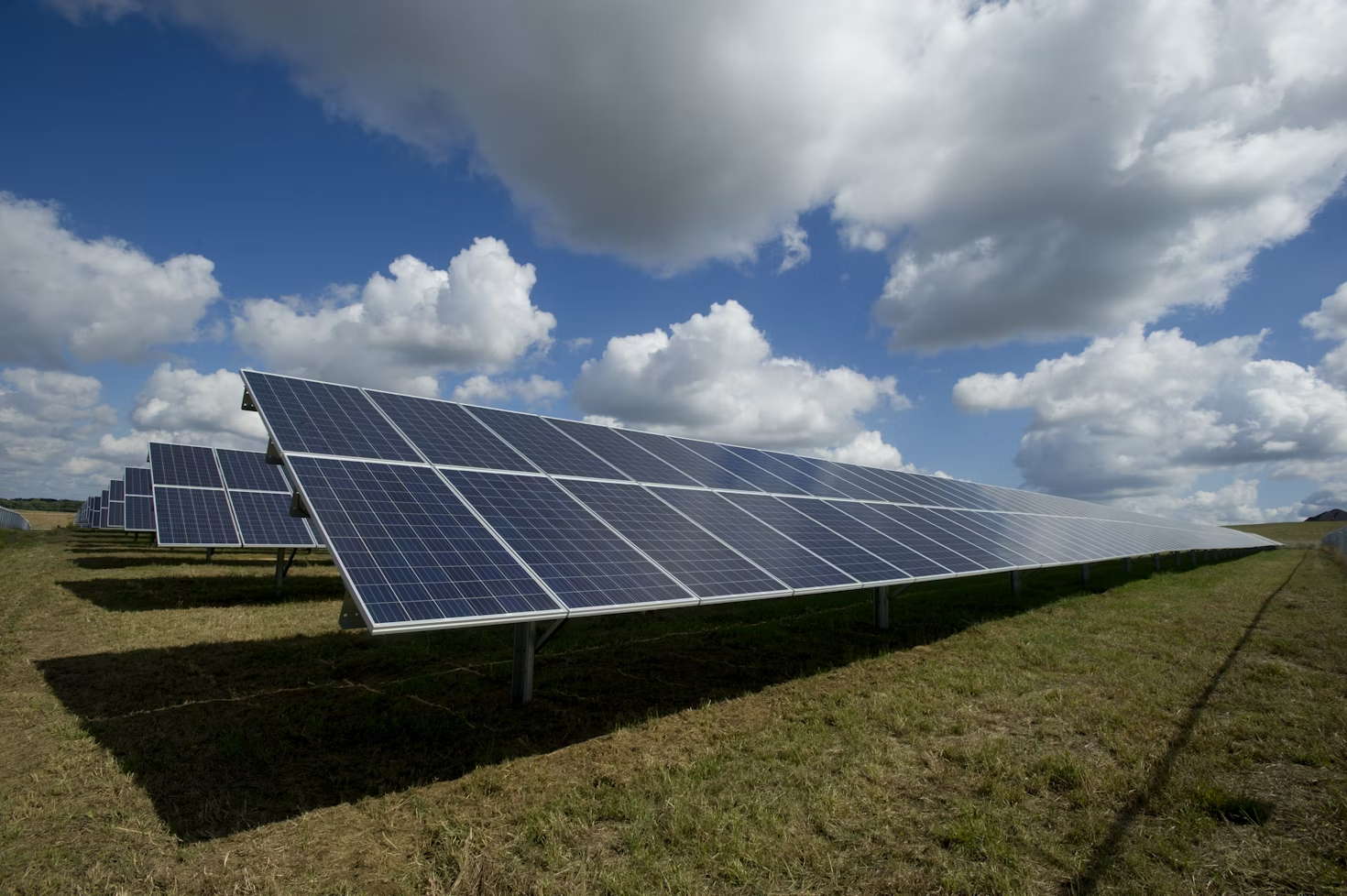
For companies with large brick-and-mortar locations, on-site solar continues to be a cornerstone of their energy procurement strategy, with historical leaders expanding into new markets.
On-site solar remains key for companies with significant energy demand and aggressive climate goals, benefiting from established industry partnerships and streamlined development processes.
Google has emerged as the top corporate adopter with 312 MWac of storage capacity - 25% more than the rest of the top ten combined.
Storage Benefits for Corporations:
Kaiser Permanente has installed battery-powered microgrids at medical centers for resilience, while Starbucks uses storage to support EV charging stations.
As storage becomes crucial to the energy transition, corporations are leveraging these investments to meet specific operational goals while supporting broader decarbonization efforts.
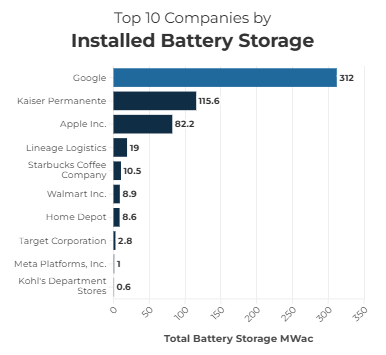
312 MWac capacity
Market Trend
25% more than next 9 combined
Battery storage represents the next wave of corporate renewable strategy, complementing both on-site and off-site solar projects with enhanced flexibility and reliability.
As costs decline and technology improves, storage is becoming a key tool for corporations to achieve 24/7 clean power and operational resilience.
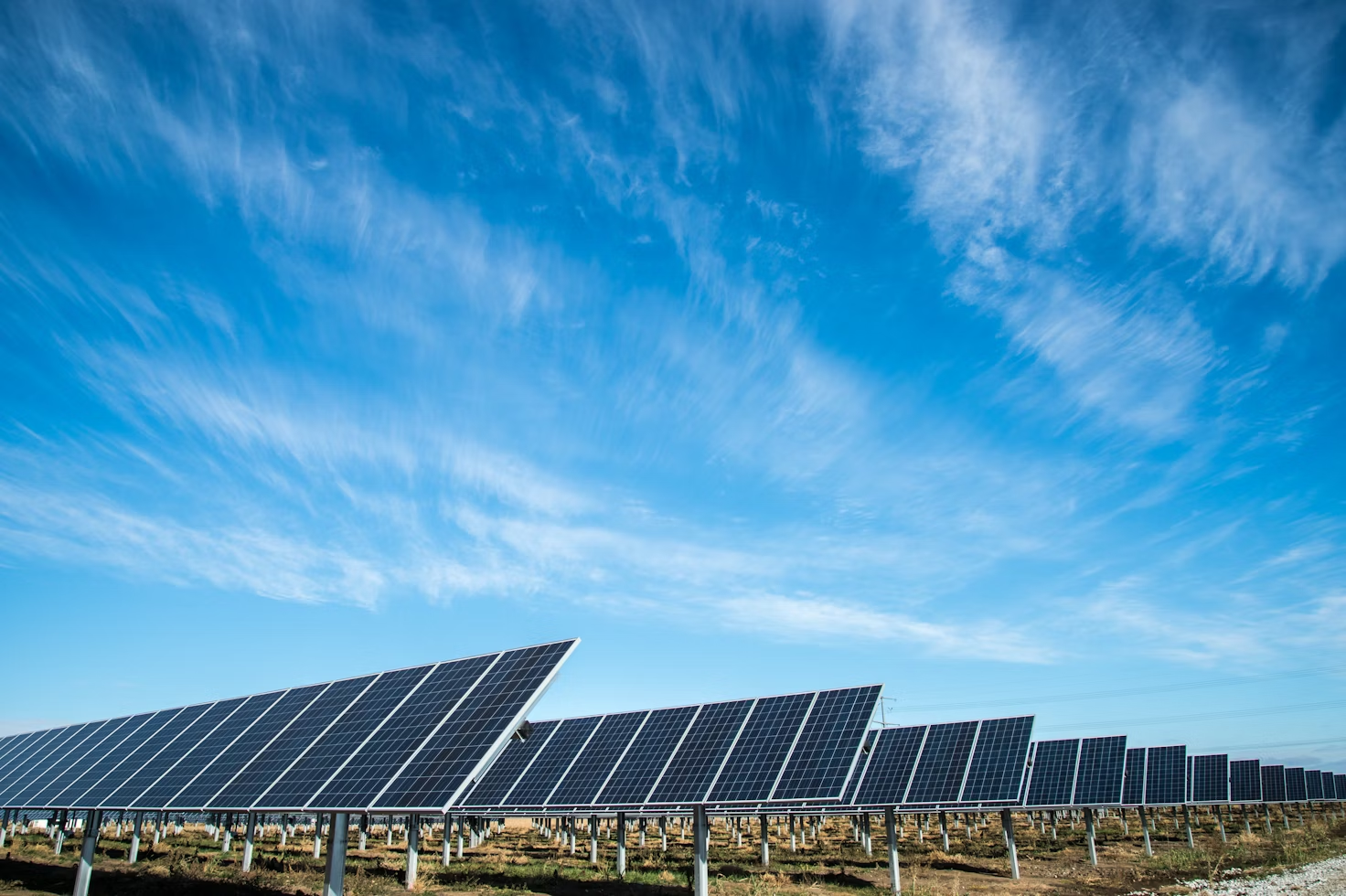
The top 10 corporate buyers currently hold a pipeline of 27.8 GWdc of solar - more than all U.S. solar capacity added in 2022.
Companies are expanding beyond traditional solar procurement into battery storage development and innovative strategies like microgrids, ancillary services participation, and solar tax equity investments.
Driven by commercial load growth and sustainability ambitions, solar is becoming the preferred energy solution for growing businesses, with pipelines continuing to expand.
Top 10 Total
27.8 GWdc
Amazon Share
13.6 GWdc
2022 Comparison
Larger than all 2022 additions
Corporate solar pipelines are reshaping energy markets, with tech giants now driving utility-scale development and pioneering new business models for renewable procurement.
As pipelines convert to operational projects, they're creating new standards for corporate clean energy leadership while accelerating grid decarbonization.
Companies setting the standard for commercial solar adoption
35% of industrial solar capacity
Leading in PPAs
Rooftop solar leaders
Green investment drivers
Flexible solutions designed for businesses of all sizes
Rooftop and ground-mounted systems for direct consumption
Virtual power purchase agreements for large-scale solar
Shared solar programs for businesses without suitable sites